
Genus Oryx · de Blainville, 1816

Lord of the desert

Horns like spears, a face painted black and white, and the power to live where almost nothing survives. This is the story of the oryx, the antelope that inspired the legend of the unicorn.

4
recognised species
120cm
horns of the scimitar-horned oryx
2
species back from extinction in the wild
20yrs
life expectancy
What is an oryx

An antelope built for the desert

The oryx is a large antelope of the bovid family that lives in the most arid regions of Africa and the Arabian Peninsula.

All species share an unmistakable design: a sturdy body, a tufted tail, a facial mask of black and white patches and long horns, straight or curved, carried by both males and females. The name comes from the Greek ὄρυξ (óryx), meaning “pickaxe” or digging tool, perhaps because of those sharp horns.

  • KingdomAnimalia
  • ClassMammalia
  • OrderArtiodactyla
  • FamilyBovidae
  • SubfamilyHippotraginae
  • GenusOryx
In profile, its two horns look like one. That, many believe, is how the myth of the unicorn was born.
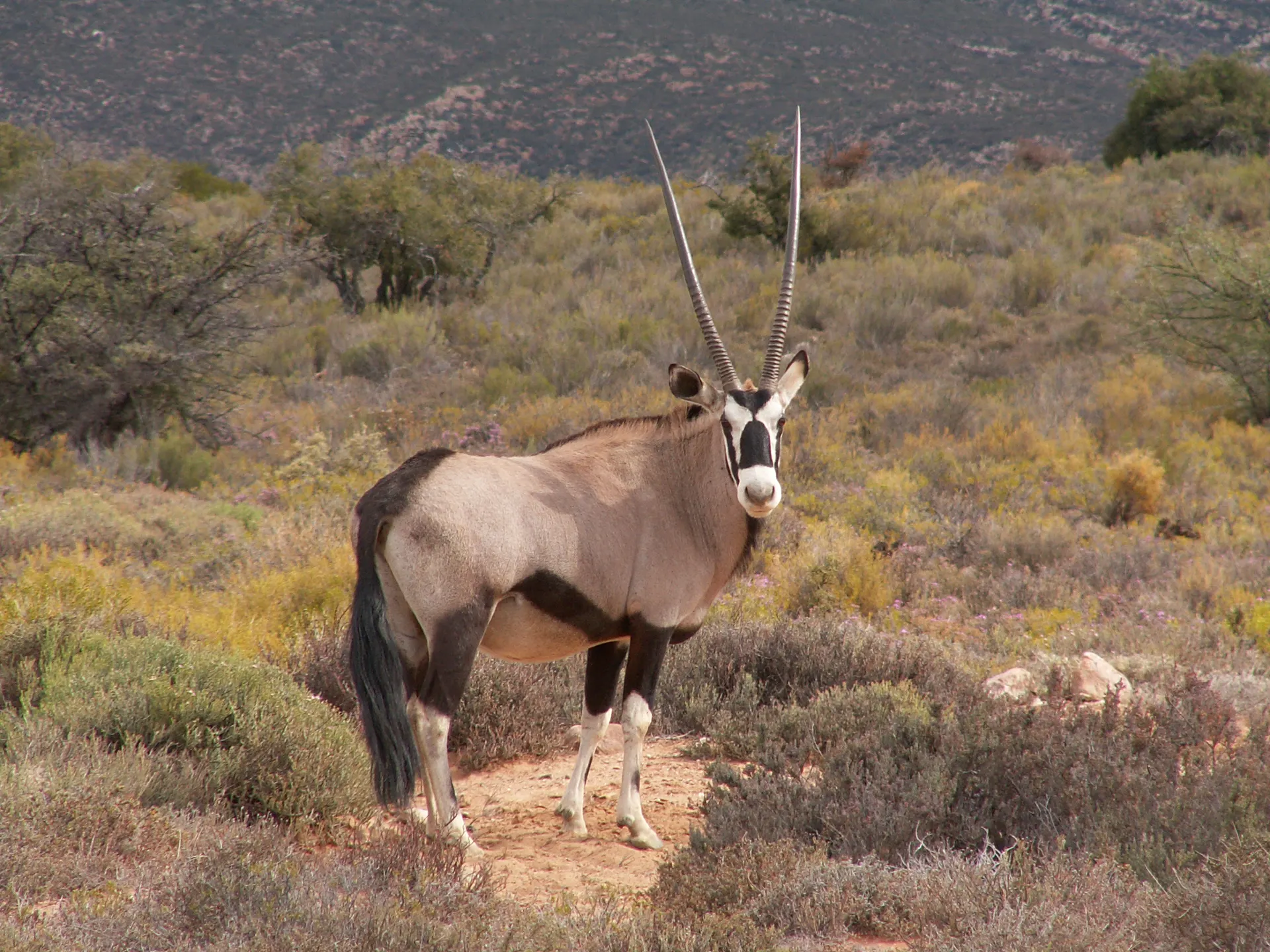
A male gemsbok facing the camera with its long straight horns in semi-arid scrub in South Africa
Gemsbok (Oryx gazella) in Anysberg Nature Reserve, South Africa.
History

Five thousand years alongside humans

From the temples of Egypt to the brink of extinction and back to the desert: few species have a story so tied to our own.

  1. Ancient Egypt

    The pharaohs’ antelope

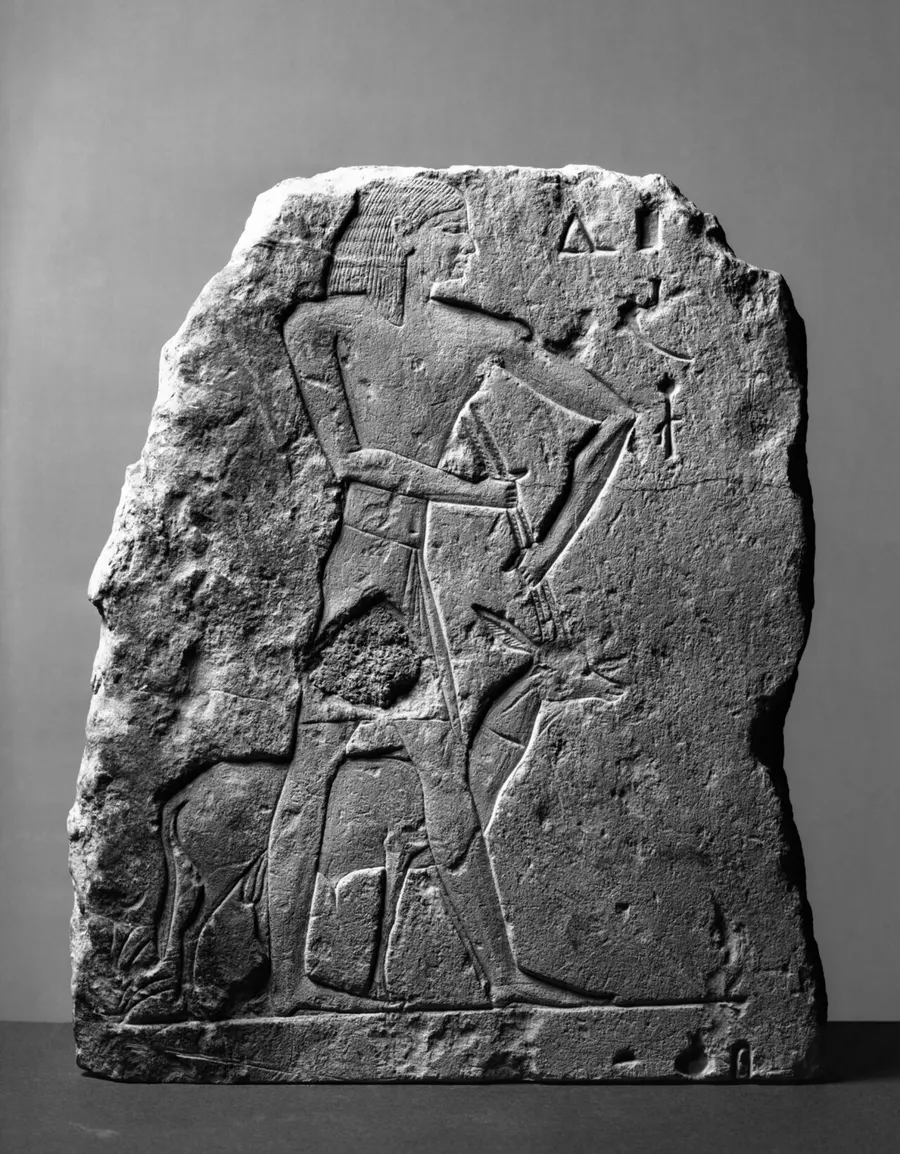
    Egyptians depicted the oryx in tomb reliefs and kept and bred it in captivity, probably as a religious offering and as food. The scimitar-horned oryx was the emblem of the Oryx nome, the 16th province of Upper Egypt, whose Middle Kingdom governors were buried at Beni Hasan.

    Fragment of an Egyptian stone tomb relief: an attendant holds an oryx by its horns
  2. 4th century BC – 1st century AD

    A unicorn is born

    Aristotle and, later, Pliny the Elder described the oryx as a one-horned animal. Seen from the side, an oryx does look like a unicorn; and if it loses a horn in a fight, it truly becomes one. The legend would travel through medieval bestiaries for centuries.

  3. 1758 – 1835

    Science gives it a name

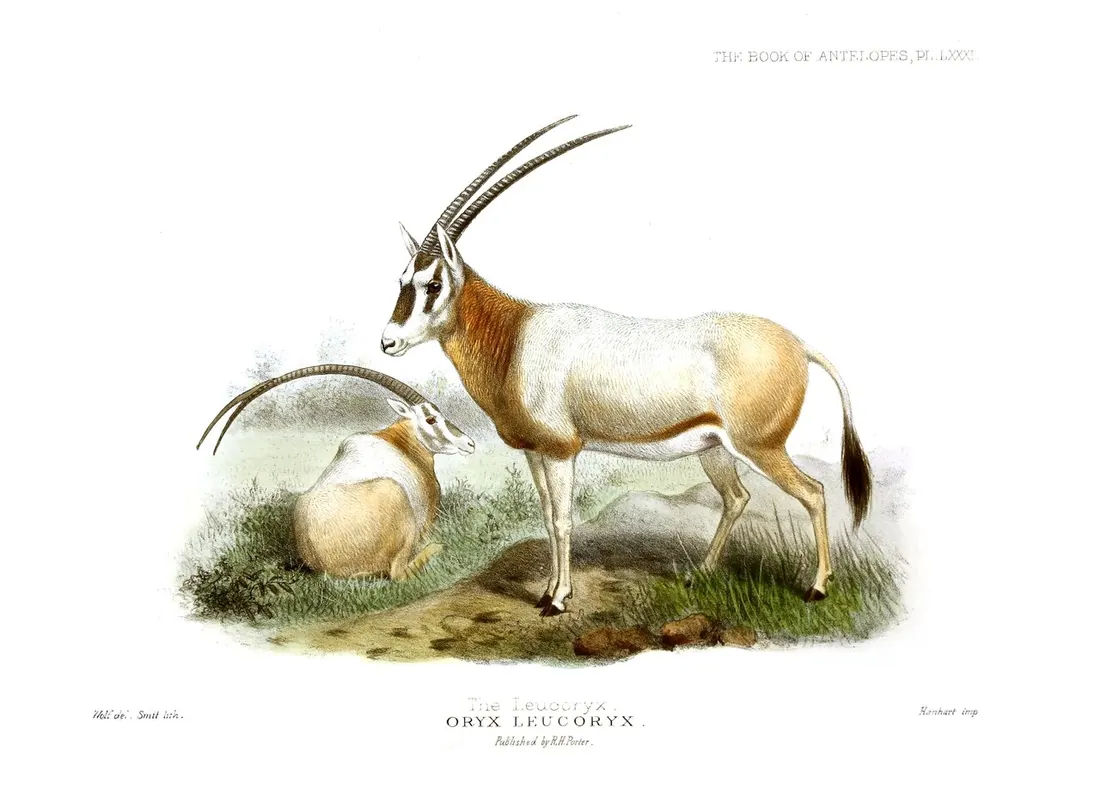
    Linnaeus described the gemsbok in 1758; Pallas the Arabian oryx in 1777; Henri de Blainville created the genus Oryx in 1816; the scimitar-horned (1827) and the beisa (1835) followed.

    Antique colour plate of an adult Arabian oryx and a resting calf
  4. 1962

    Operation Oryx

    With the Arabian oryx about to vanish, the Fauna Preservation Society captured some of the last wild animals in southern Arabia. Together with animals donated by other collections, they formed the “World Herd” at Phoenix Zoo, Arizona, with just nine animals.

  5. 1969 – 1977

    Gemsbok in New Mexico

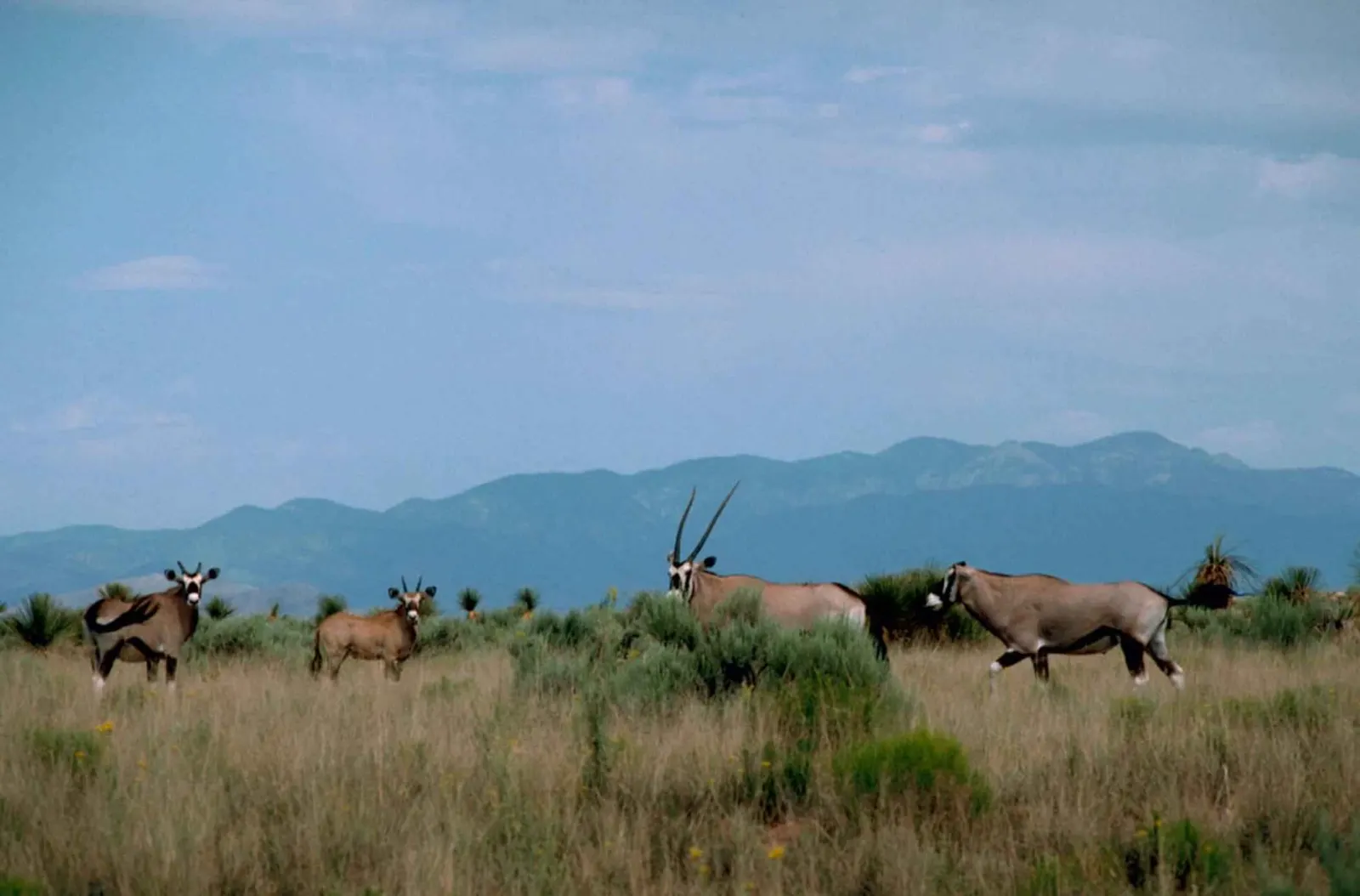
    Ninety-three Kalahari gemsbok were released on the White Sands Missile Range, USA. With no natural predators, thousands live there today.

  6. 1972

    Extinct in the wild

    Hunters shot the last free-living Arabian oryx at Jiddat al-Harasis, Oman. The species survived only in captivity.

  7. 1982

    The return

    Ten descendants of the World Herd were released into the desert of central Oman. Reintroductions followed in Saudi Arabia, the UAE, Israel and Jordan.

  8. 2000 – 2023

    The scimitar returns to the Sahel

    Declared extinct in the wild in 2000, the scimitar-horned oryx was reintroduced to Chad from 2016. In 2023 the IUCN downlisted it to Endangered: it had come back from extinction.

Types of oryx

Four species, one spirit

Science recognises four species in the genus Oryx. The fringe-eared oryx is usually treated as a subspecies of the beisa, although some authors consider it a fifth.

A group of gemsbok grazing on a grassy plain with mountains behind LC Least Concern
Oryx gazella

Gemsbok

The largest and heaviest. Greyish-fawn coat, lots of black on the legs and flanks, an all-black tail and white “socks”. Its straight horns average about 85 cm; females’ are longer and thinner.

  • Weight180–240 kg
  • Height1.2 m
  • Horns≈ 85 cm

Namibia, Botswana, South Africa and parts of Zimbabwe (Kalahari and Namib deserts).
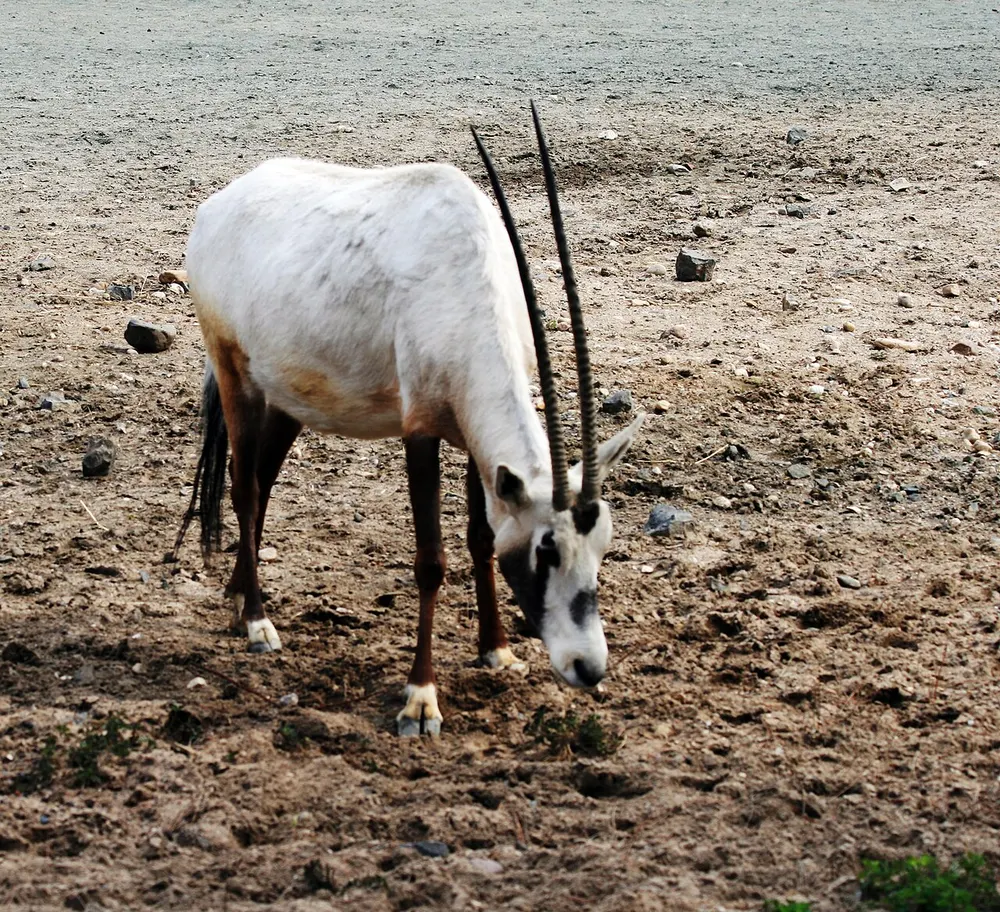
White Arabian oryx with long straight horns grazing on stony ground VU Vulnerable
Oryx leucoryx

Arabian oryx

The smallest and the whitest: its pale coat reflects the sun of the Empty Quarter. It went extinct in the wild in 1972 and roams the desert again today.

  • Weight65–75 kg
  • Height0.8–1 m
  • Horns50–75 cm

Oman, Saudi Arabia, United Arab Emirates, Israel and Jordan (reintroduced populations).

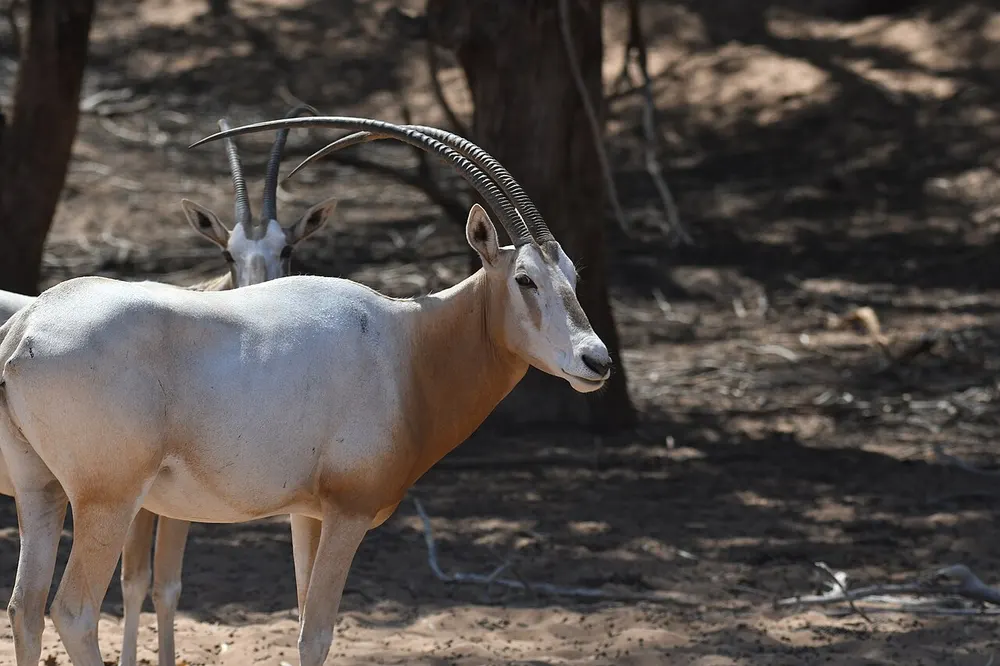
White scimitar-horned oryx with a reddish neck and backward-curving horns EN Endangered
Oryx dammah

Scimitar-horned oryx

White with a russet neck and chest and horns arched like sabres. It once migrated across the Sahel in herds of thousands; it vanished from the wild in 2000.

  • Weight140–210 kg
  • Height≈ 1–1.1 m
  • Horns100–120 cm

Sahel and southern Sahara; reintroduced in Chad (Ouadi Rimé–Ouadi Achim), and in Tunisia, Morocco and Senegal.

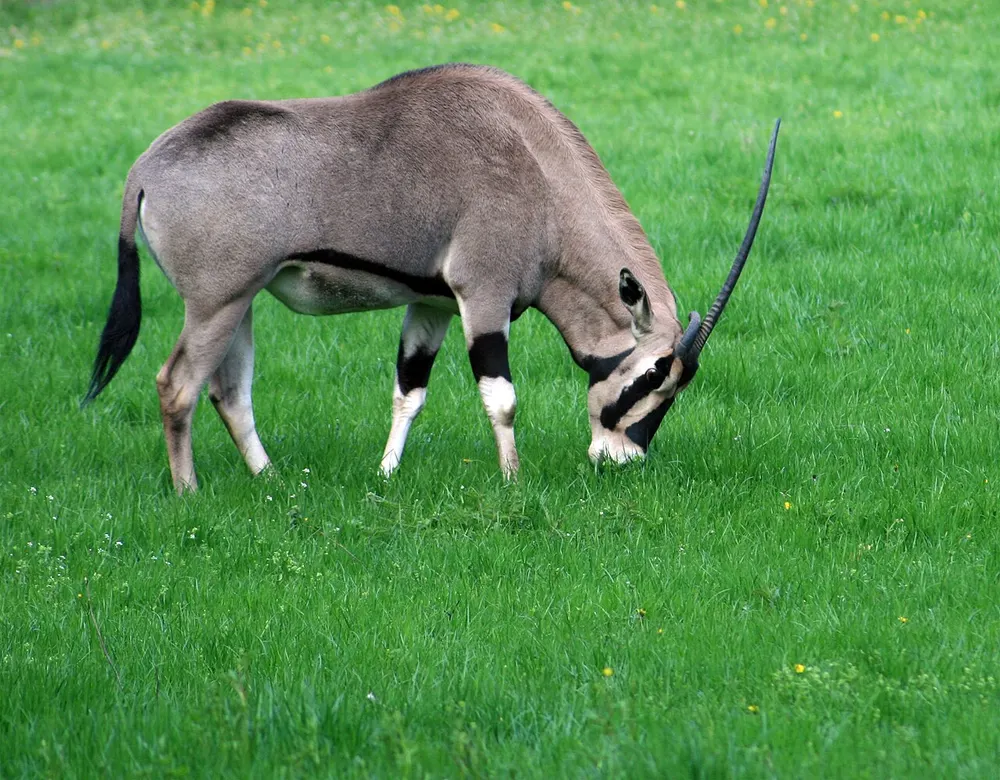
Grey beisa oryx with black facial markings grazing on green grass EN Endangered
Oryx beisa

Beisa oryx

The oryx of East Africa. Slimmer than the gemsbok, grey with a white belly separated by a black stripe, and with far less black on the legs.

  • Weight115–190 kg
  • Height1.1–1.2 m
  • Horns75–80 cm

Ethiopia, Somalia, Djibouti, Eritrea and northern Kenya (Horn of Africa).

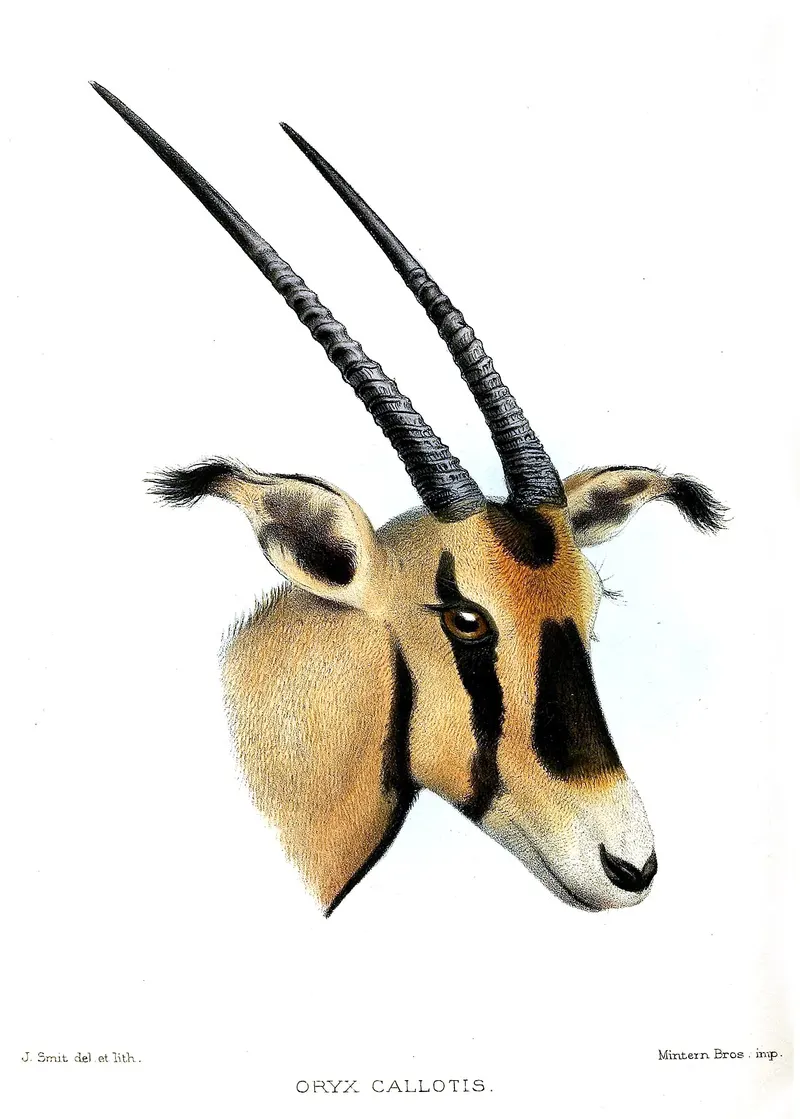
Antique illustration of a fringe-eared oryx head with black tufts on the ears EN With beisa Subspecies
Oryx beisa callotis

Fringe-eared oryx

A close relative of the beisa, more cinnamon in tone and with black tufts at the tips of its ears, hence its name.

  • Weightlike the beisa
  • Heightlike the beisa
  • Horns≈ 75–80 cm

Southern Kenya (south of the Tana River) and northern Tanzania.

Quick comparison
SpeciesWeightHornsCoatIUCN
Gemsbok180–240 kgStraight, ≈ 85 cmGreyish-fawn, lots of black on legsLeast Concern
Arabian oryx65–75 kgStraight, 50–75 cmWhite, dark legsVulnerable
Scimitar-horned oryx140–210 kgCurved, 100–120 cmWhite, russet neckEndangered
Beisa oryx115–190 kgStraight, 75–80 cmGrey, white bellyEndangered
Quick guide

How to tell a gemsbok from a beisa

They are the two most similar oryx. Just check three things: where it is, how much black it has on its legs and what its tail looks like.

Gemsbok in profile with black legs and white socks
Oryx gazella

Gemsbok

  • WhereSouthern Africa
  • LegsBlack upper legs and thighs, with a patch on the hind legs too
  • TailAll black, with a black patch at its base
  • FlanksBlack on the lower flanks too
  • SizeLarger and sturdier: 180–240 kg
Grey beisa oryx with pale legs
Oryx beisa

Beisa oryx

  • WhereEast Africa and the Horn of Africa
  • LegsGrey on top; black only as bands near the knees
  • TailNot entirely black
  • FlanksJust one black stripe between the grey and the white belly
  • SizeSlimmer: 115–190 kg

Check the map. In the wild their ranges don’t meet: in southern Africa it’s a gemsbok; in the east, a beisa.

Check the legs. Black thighs and upper legs: gemsbok. Grey like the body: beisa.

  • Arabian oryx: the smallest, almost white, with dark legs.
  • Scimitar-horned oryx: the only one with backward-curving horns, plus a russet neck and chest.
  • Fringe-eared oryx: like a more cinnamon beisa, with tufts of hair at the tips of its ears.
Habitat

Where the horizon burns

Sand and stone deserts, semi-deserts, steppes and dry savannas: the oryx inhabits some of the hottest and driest places on the planet.

It lives in herds that travel long distances following the rains and fresh grazing. It can go weeks without drinking and spends the hottest hours of the day in the shade of acacias or rocks.

Kalahari & Namib

O. gazella · red dunes, salt pans and dry savanna.

Horn of Africa

O. beisa · thorn scrub and arid plains.

Sahel

O. dammah · steppe between the Sahara and the savanna.

Arabia

O. leucoryx · gravel plains and the dunes of the Empty Quarter.

Schematic map of oryx distribution in Africa and Arabia SAHEL · O. dammah ARABIA O. leucoryx O. beisa O. b. callotis O. gazella Chad Oman
Current range Historic range Key reintroductions

Flexible thermostat

Rather than spending water on cooling, it lets its body temperature rise during the day and sheds the heat in the cool of the night. Daily swings of about 4 °C have been measured in wild Arabian oryx.

A cooled brain

A network of blood vessels in the muzzle, the rete mirabile, cools the blood flowing to the brain even when the body is very hot.

Every drop counts

Highly concentrated urine and dry droppings. It gets much of its water from food: wild melons and cucumbers can supply all the water a gemsbok needs.

Mirror coat

The almost luminous white coat of the Arabian oryx reflects much of the sun’s radiation and helps it avoid overheating in the desert sun.

Hooves for sand

Broad hooves spread its weight, letting it walk on soft sand and gravel and cover huge distances.

Rain seeker

The Arabian oryx is believed to sense distant storms and travel towards them to find the grazing that sprouts after rain.

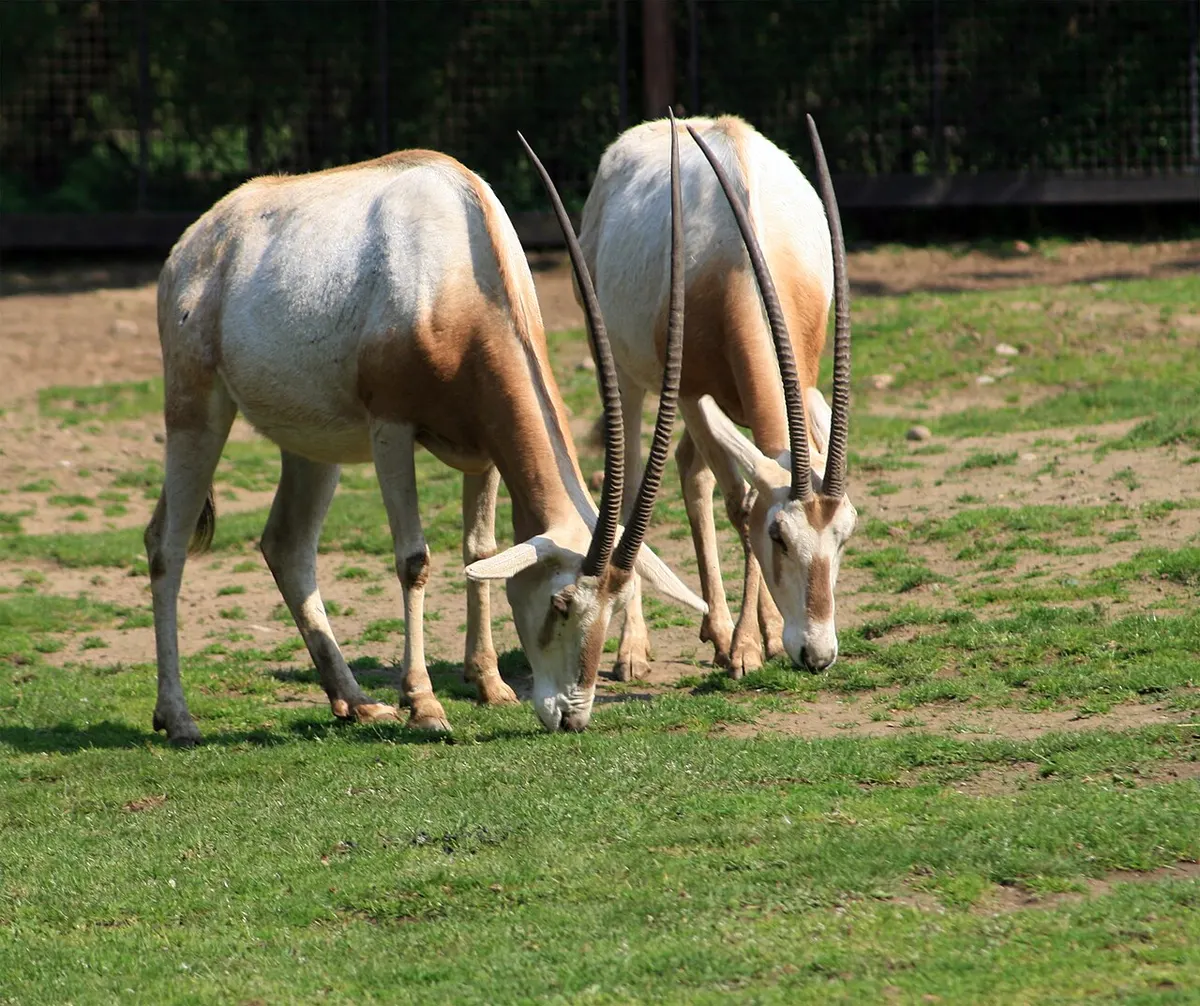
Two scimitar-horned oryx grazing green grass with heads lowered
Scimitar-horned oryx grazing.
Diet

Drinking without water

The oryx is a herbivore and ruminant: its four-chambered stomach lets it get the most out of even the poorest grazing.

It grazes grasses when available and browses shrub leaves when they are scarce. It can dig up to a metre deep for roots, bulbs and tubers that hold moisture, and seeks out juicy fruits such as tsamma melons and the wild cucumbers of the Kalahari.

  • Grasses
  • Tender shoots
  • Shrub leaves
  • Roots and tubers
  • Bulbs
  • Wild melons
  • Wild cucumbers
  • Succulents

Its great trick is feeding at night and at dawn: at those hours some desert plants absorb moisture from the air and hold more water than at midday.

A day in the life of an oryx

Typical summer rhythm (varies by species, season and region).

Reproduction

The circle of life

The oryx has no fixed rutting season: it can breed all year round, although births increase after the rains, when food is plentiful.

Herds of 2 to 40 animals are usually led by a dominant male, who faces rivals in horn duels. During courtship the male follows the female and gently taps her between the hind legs with a foreleg, a ritual ethologists call Laufschlag.

  1. Courtship

    All year round

    Peaks after the rainy season.

  2. Gestation

    8 – 9 months

    About 240 days in the Arabian oryx and 270 in the gemsbok.

  3. Birth

    1 calf

    Usually just one; scimitar-horned calves weigh 10 to 15 kg.

  4. Hiding

    Up to 6 weeks

    The calf lies hidden in the vegetation; the mother returns to nurse it.

  5. Weaning

    3.5 – 4.5 months

    Weaning starts at 3.5 months; by about 4.5 it is independent.

  6. Maturity

    1.5 – 2 years

    Both males and females, in gemsbok and scimitar-horned oryx.

  7. Lifespan

    ≈ 20 years

    About 18–20 years in the wild and up to about 20 in captivity.

Female scimitar-horned oryx walking with her fawn-coloured calf beside her
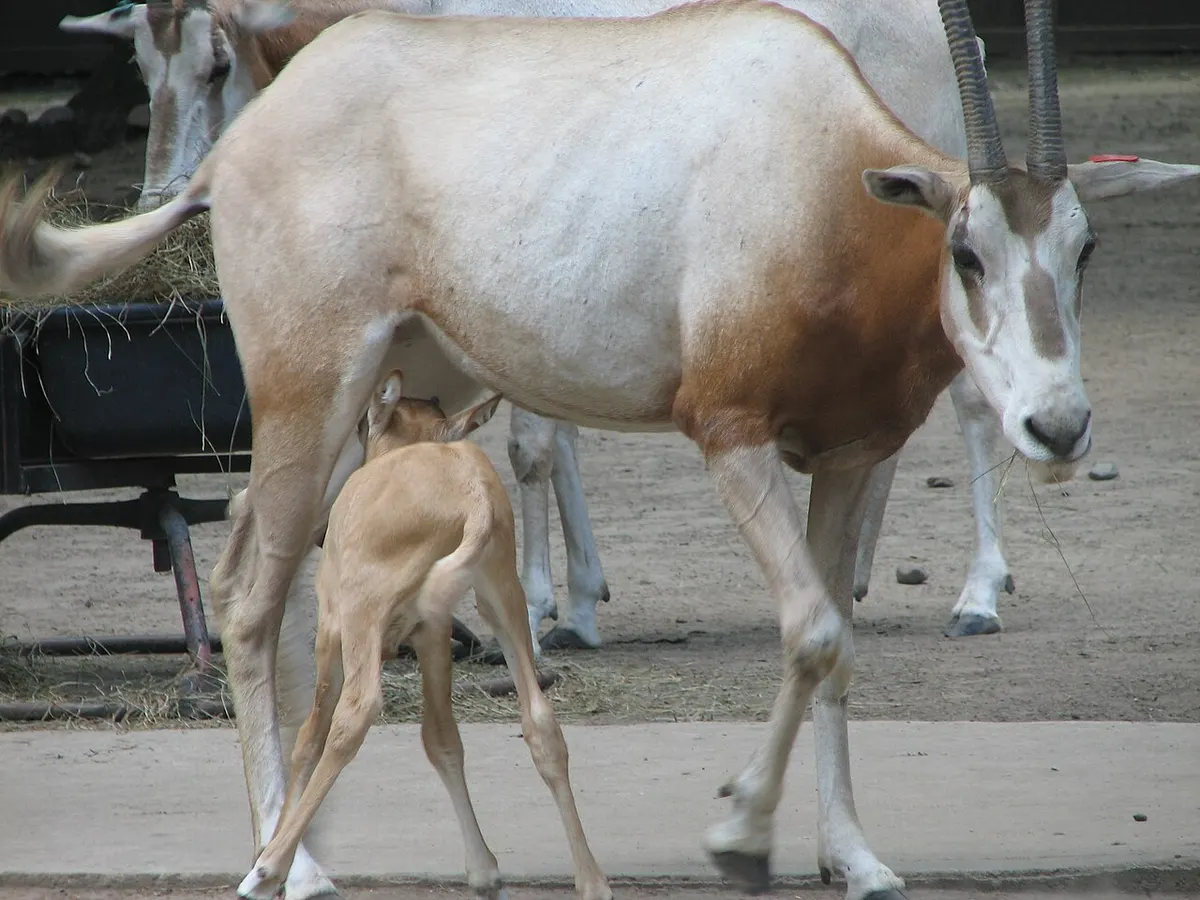
Calves are born fawn-coloured, with their horns barely visible.
Adult Arabian oryx next to a light brown calf
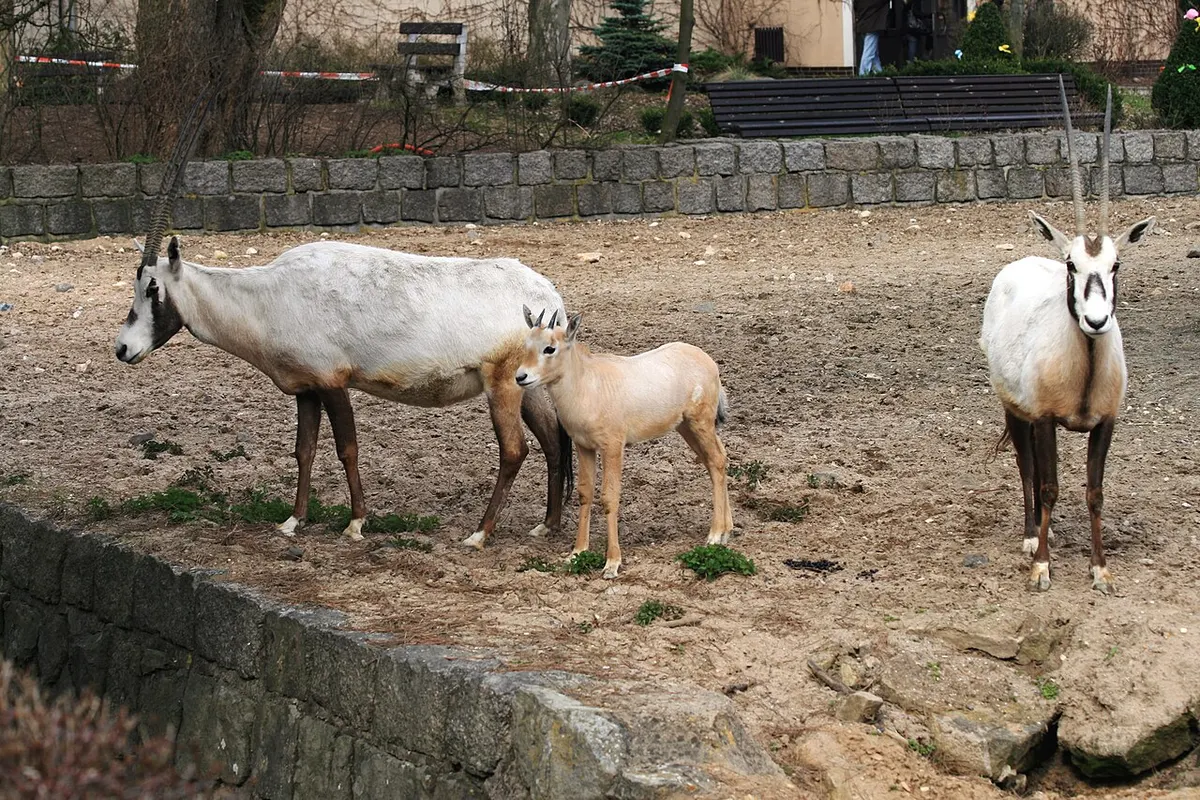
An Arabian oryx calf with its herd.
Conservation

Back from extinction

Two oryx species disappeared completely from the wild and came back. They are two of the greatest conservation successes in history.

2011

The Arabian oryx, from extinct to vulnerable

It was the first animal to improve three categories on the IUCN Red List after going extinct in the wild. Today more than 1,000 live free, with thousands more in reserves and zoos.

2023

The scimitar returns to the Sahel

Thanks to reintroduction in the Ouadi Rimé–Ouadi Achim reserve (Chad), the species moved from “Extinct in the Wild” to “Endangered”. Calves are now born in the wild.

2007

A bitter lesson

Oman’s Arabian Oryx Sanctuary became the first site ever removed from the UNESCO World Heritage List, after Oman cut its area by 90% for hydrocarbon prospecting and its oryx population fell from 450 to 65.

Main threats

  • Hunting and poaching
  • Habitat loss
  • Competition with livestock
  • Drought and climate change
  • Armed conflict
  • Capture for private collections
Fun facts

Things you might not know

Myth

The real unicorn

Seen in profile, its two horns overlap and look like one. Many historians believe the oryx inspired the legend of the unicorn.

Weapons

Respected by lions

Its horns are formidable weapons. Since the 19th century there have been accounts of lions run through by the horns of a cornered gemsbok.

Her too

Horns on both sexes

Males and females both have horns. Females’ horns are usually thinner and sometimes even longer.

Symbol

On Namibia’s coat of arms

Two gemsbok support Namibia’s national coat of arms, a symbol of courage, elegance and pride.

Icon

Emblem of Qatar

The Arabian oryx is the national animal of Qatar, Oman, Jordan, the UAE and Bahrain, appears on the tails of Qatar Airways planes and was “Orry”, the mascot of the 2006 Asian Games in Doha.

Travellers

Africans in New Mexico

The White Sands gemsbok have adapted so well to the Chihuahuan Desert that they now number around 3,000.

Family

Cousins of the sable antelope

The oryx belongs to the subfamily Hippotraginae, along with the sable and roan antelopes, Africa’s other great “horse antelopes”.

Record

Horns over a metre long

Scimitar-horned oryx horns measure 1 to 1.2 metres, in both males and females. In 1936 a single herd of 10,000 was seen in Chad.

Frequently asked questions

Everything you want to know

How many species of oryx are there?

Four species are recognised: the gemsbok (Oryx gazella), the beisa oryx (Oryx beisa), the scimitar-horned oryx (Oryx dammah) and the Arabian oryx (Oryx leucoryx). The fringe-eared oryx (Oryx callotis) is considered a subspecies of the beisa or, by some authors, a fifth species.

Where does the oryx live?

In deserts, semi-deserts and dry savannas of Africa and the Arabian Peninsula: the Kalahari and Namib, the Horn of Africa, the Sahel and the deserts of Arabia.

What does the oryx eat?

It is a herbivore and ruminant: it eats grasses, shoots, shrub leaves, roots, bulbs and water-rich fruits such as wild melons and cucumbers. It gets much of the water it needs from its food.

How long can an oryx go without drinking?

Several weeks. It gets water from the plants, roots and fruits it eats, produces highly concentrated urine and lets its body temperature rise during the day to save water. The gemsbok can meet all its water needs by eating wild melons and cucumbers.

How long does an oryx live?

About 18 to 20 years in the wild, and up to about 20 in captivity.

Is the oryx endangered?

It depends on the species: the gemsbok is Least Concern, the Arabian oryx is Vulnerable, and the beisa and scimitar-horned oryx are Endangered. The Arabian and scimitar-horned oryx both went extinct in the wild and returned thanks to captive breeding and reintroduction.